Search engines depends on the anchor text to decipher the importance and purpose behind a link. If the anchor text closely relates to the content topic and is in the right context, it will reinforce the page’s authority and result in better search visibility. On the contrary, if the anchors consist of the same keyword, sound forced or are disconnected from the surrounding content, the page’s rankings will not change, there will be more volatility, and the risk of either automated or manual actions due to filters becomes more possible.
An effective anchor text strategy involves not keyword stuffing but rather relevance, variety, and natural patterns that indicate to Google the associating meaning with the authority.
With the help of this guide, you will find out how anchor text functions, the strategic ways of using it, and the building of a solid, natural anchor profile which not only enhances the rankings but also avoids penalties.
What Is Anchor Text?
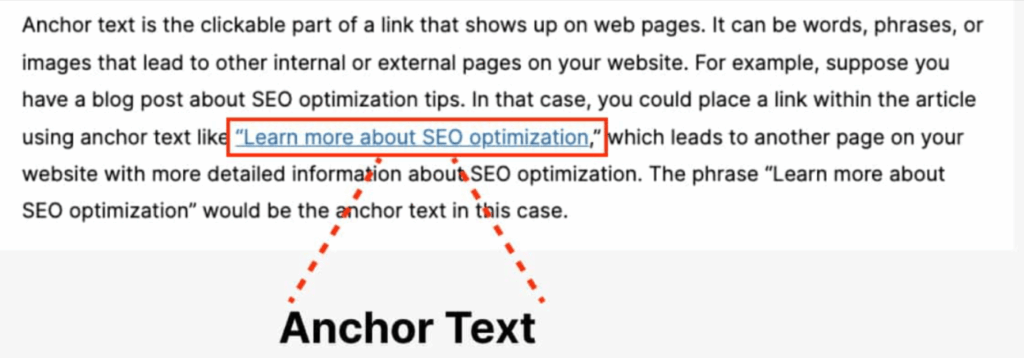
Anchor text is the text that is clickable and that is used to form a hyperlink. Search engines use it to determine the topic of the linked page and its proper placement in the overall topic landscape. In this context, anchor text serves as a signal that links authority with keyword relevance from the SEO perspective.
There are different types of anchors, and it is important to know how they can help or hinder the ranking strategy before going ahead with link building or acquisition.
Why Anchor Text Matters for SEO
Google gets its topical context from anchor text. For instance, a page that has links with keywords like best project management software, project management SaaS, or project tools gets associated with those concepts by the search engines. Ranking potential increases as more authoritative links support the pattern.
Additionally, anchor text affects:
- Crawl prioritization: When clear anchor context exists, Google can classify the link’s purpose faster.
- Topical authority: Consistent, relevant anchors strengthen semantic relevance across a niche.
Anchor text does not work in isolation—it works alongside content quality, link authority, and contextual relevance.
Types of Anchor Text and Their Strategic Use
Exact Match Anchors
These anchors match the exact keyword you want to rank for. While they can provide strong relevance signals, Google treats aggressive, repeated exact match anchors as manipulation. They are useful but should be applied sparingly and only when placement context is solid and natural.
Partial Match Anchors
Partial match anchors include a variation of the keyword along with additional words. These offer ranking relevance without appearing manipulative and are often the safest option for scalable link building.
Example: tools for email automation instead of just email automation.
Branded Anchors
Branded anchors include the company or product name. They help build trust and identity and balance the anchor profile. Strong brands naturally attract branded anchors, which is why Google treats them as low risk and extremely natural.
Naked URLs
These anchors are simply raw URLs, such as example.com. They provide minimal topical relevance but add diversity. They are common in resource pages, citations, and references.
Generic Anchors
Terms like click here, learn more, or visit site offer no SEO value but may assist user experience in UI-driven content. They should be minimal but not excluded entirely, since natural link profiles often contain them.
Image Anchors
For image-based links, the ALT text serves as the anchor. When optimized naturally, image anchors contribute additional contextual relevance—especially on visual-heavy platforms or design-focused content.
Anchor Text Relevance and Search Intent
Search engines assess anchor texts as a whole rather than separately. In other words, they consider the content of the anchor, its position, and if it is logical according to the neighboring content and the page to which it links.
A relevant anchor follows three core alignment rules:
Anchor to Surrounding Content Match
If the sentence and paragraph around the anchor discuss the same topic as the anchor itself, Google can identify the link as natural and contextual.
Example: A blog explaining email outreach strategies linking to a page about email automation software feels logical and relevant.
Anchor to Page Intent Match
The anchor must match what users expect when they click. If someone clicks best invoicing tool but lands on a generic business homepage, the intent mismatch weakens the signal.
When the destination page clearly fulfills the keyword promise, ranking signals are reinforced.
Anchor to Domain Theme Match
Links from domains covering similar or closely related topics carry stronger semantic value.
A finance anchor coming from a gaming or recipe blog looks out of place, even if the anchor text itself is accurate.
Anchor Text Distribution and Natural Patterns
There’s no fixed ratio for anchor usage. Google looks for patterns that resemble natural, organic link acquisition rather than manipulated links.
Majority Branded Anchors : Branded anchors reflect genuine mentions of a company or product. Most links naturally use brand names, which signals trust and authenticity to search engines.
Balanced Partial Match Anchors : Partial match anchors combine a keyword with contextual words, like tools for SEO optimization. They provide relevance without looking forced and help connect authority to the target topic naturally.
Limited Exact Match Anchors : Exact match anchors should be used sparingly. Overusing them across multiple domains can appear manipulative, triggering penalties. When used in relevant contexts on authoritative sites, they boost ranking safely.
A Mix of URL and Generic Anchors : URL anchors (example.com) and generic phrases (read more, visit site) add diversity. They may not carry strong keyword value, but they make the anchor profile look natural and realistic.
Risks of Over Optimized Anchor Text
After Google’s Penguin updates, the most common cause of manual action in link profiles became anchor over optimization. Patterns that trigger risk include:
- Repeated exact match keywords across different websites
- Anchors placed in irrelevant, low-quality, or spam environments
- Identical anchors appearing in guest posts, PBNs, or directory submissions
Once flagged, ranking recovery may take months—even after fixing the issue—because trust signals need time to reset.
Internal vs External Anchor Text Strategy
Internal Anchors
Internal linking with strategic anchors helps establish website architecture and topic clusters. It signals which pages are primary, supporting, or contextual. Internal anchors can safely use more exact match or partial match variations because they remain under the same domain.
External Anchors
External anchors require stricter control. Relevance, placement quality, domain context, and anchor variation matter significantly more. External anchor patterns should reflect natural usage—not keyword manipulation.
How to Optimize Anchor Text for Maximum Impact
The process of optimizing anchor text is not an increase in keywords but it is proper planning and naturalness and relevance. A planned approach guarantees the maximum linking power of each link and at the same time keeps away from penalties.
Anchor Text Mapping
Before building or acquiring links, map each target page with a clear anchor strategy. Assign the right mix of branded anchors, partial match anchors, contextual phrases, and a limited number of exact match anchors. This prevents over optimization and ensures each page receives links that reinforce its primary topic without looking manipulative.
Semantic Variation
Avoid using the same keyword repeatedly. Instead, incorporate variations, synonyms, and long form phrases in your anchors.
For example, instead of repeatedly linking with email marketing tools, you can use best tools for email marketing, email automation software, or tools to improve email campaigns.
Context First Placement
Always place anchors within natural sentences that provide context for the link. Anchors should make sense to both users and search engines.
As an example, if a text about speed optimization contains the phrase improve website performance, its connection to the landing page would be even more clearly established.
Authority Priority
Prioritize optimized anchors on high quality, relevant, and trusted sources. Even a perfectly optimized anchor on a low-quality or irrelevant site has minimal impact and may pose risk. Links from editorially controlled, niche-relevant, and authoritative domains amplify the value of your anchor strategy and strengthen rankings safely.
Optimized anchor strategy is intentional—not random. Every link should support topic alignment.
Tools to Analyze and Improve Anchor Text Distribution
Modern SEO tools can reveal anchor text toxicity, overuse, and contextual problems:
- Ahrefs Anchor Cloud shows anchor diversity and ratio patterns.
- Semrush Backlink Analytics highlights keyword driven anchor trends and risks.
- Majestic Anchor Distribution evaluates trust flow relevance based on anchor context.
- LinkResearchTools Anchor Audit detects anchor manipulation and offers toxicity scoring.
Regular monitoring prevents unnatural patterns and supports long-term ranking stability.
Common Mistakes to Avoid
Anchor-related SEO issues often stem from poor planning, shortcuts, or templates. Mistakes include:
- Using the same exact match anchor in every guest post or outreach campaign.
- Placing keyword anchors in low trust pages or irrelevant content themes.
- Relying on forced contextual positioning rather than natural editorial placement.
- Building anchors without considering search intent alignment.
Avoiding these mistakes ensures anchor strategy strengthens rankings instead of harming them.
Conclusion
Anchor text remains one of the most influential components of link building. It guides search engines, shapes topical identity, and distributes ranking signals. When used strategically, anchors accelerate authority and improve search visibility. When misused, they leave detectable manipulation patterns and risk penalties. The key is balance: relevance, variation, and natural distribution.
FAQs
How many exact match anchors are safe?
There is no fixed number—but exact match anchors should remain a minority and only appear in highly contextual, relevant placements.
Does anchor text still influence rankings after recent Google updates?
Yes. Google continues using anchor context as a signal, but natural distribution matters more than ever.
Should internal and external anchors follow the same rules?
No. Internal anchors can be more optimized because they live within the same domain, while external anchors require greater diversity and caution.
Can incorrect anchor text affect ranking negatively?
Yes—misaligned or spam-like anchors can confuse search relevance or trigger spam detection systems.
Do AI generated anchors create detectable patterns?
If repeated without variation, yes. AI driven templates often repeat structure, making footprints easier to detect.