Numerous local companies face the challenge of getting a high ranking on Google Maps even after applying keywords, having citations or getting reviews done. In the majority of situations, the issue is not the work—it’s the local SEO fundamentals that are either missing or broken.
A thorough local SEO audit reveals these problems by inspecting how your business is viewed by Google through Google Business Profile, local search results, and your website. It indicates whether your business information is in sync, whether your pages are accessible, whether your content is relevant to the local community, and whether your trust signals are strong enough to compete.
This article explains the entire local SEO audit process, starting with knowing your actual local competitors and finishing with checks on technical, content, review, and backlinks.
1. What a Local SEO Audit Actually Covers
A local SEO audit checks how well your business is optimized for location-based searches, such as “plumber near me” or “dentist in Delhi.”
It focuses mainly on:
- Google Business Profile (GBP)
- Local keywords and pages
- NAP consistency (Name, Address, Phone)
- Reviews and reputation
- Local backlinks and citations
- Local user experience
A local SEO audit does not focus heavily on blog SEO, global keywords, or non-local traffic.
2. Identify Your Real Local Competitors
Your real local SEO competitors are not always the same businesses you compete with offline. A business can be popular locally but still not rank in Google search or Maps. For a local SEO audit, only the businesses that Google shows in results matter.
To identify them, start by searching your main service keywords in Google. Then look closely at the Map Pack, because these businesses get the most visibility and traffic. Next, search variations like “service + city” and “service near me.” Different searches often show different competitors.
Make a list of businesses that appear again and again across these searches. These are your true local competitors and the ones you should audit against, because they already meet Google’s local ranking standards.
Define Your Service Area
Check whether your business is:
- Single location
- Multiple locations
- Service area business (SAB)
3. Google Business Profile Audit
NAP Accuracy
NAP is an acronym for Name, Address, and Phone number. Google uses these particulars to verify that your business exists and is reliable. If this data is in disagreement, your position in the local listings can be negatively impacted.
The first thing you should do is see if your business name on Google Business Profile is the same as your real brand name. Do not use extra keywords or location phrases.
Next, verify that your address is correct, complete, and in the same format as used on your website and other directories.
Finally, ensure that your phone number is operational, accessible, and corresponds with the number that is displayed on your website.
Business Description Review
Your description should:
- Clearly explain your service
- Mention your main location naturally
- Avoid keyword stuffing
It should help users understand what you do, not just search engines.
Photos and Media
Check:
- Are photos recent?
- Do they show real work, office, team?
- Are competitors posting more frequently?
Fresh and real photos improve engagement and map visibility.
GBP Features
Audit whether you are using:
- Services section
- Products (if applicable)
- FAQs
- Messaging and call buttons
Missing features reduce visibility compared to competitors who use them fully.
4. Local Keyword and Search Intent Audit
Keyword Mapping
Keyword mapping signifies the process of associating the appropriate local keywords to the respective pages of your website. This enables Google to comprehend which page should be ranking for which search.
Commence with making a list of keywords for your principal services, then include variations, e.g., service + city and service + area or neighborhood. These are the ways that customers really search for local businesses.
Each important keyword should point to one clear page only. Do not repeat the same keyword on several pages, as it causes confusion and lowers the overall ranking. An unambiguous keyword to page allocation increases the relevance and makes your local SEO audit more powerful.
5. On-Page Local SEO Audit
Local Landing Pages
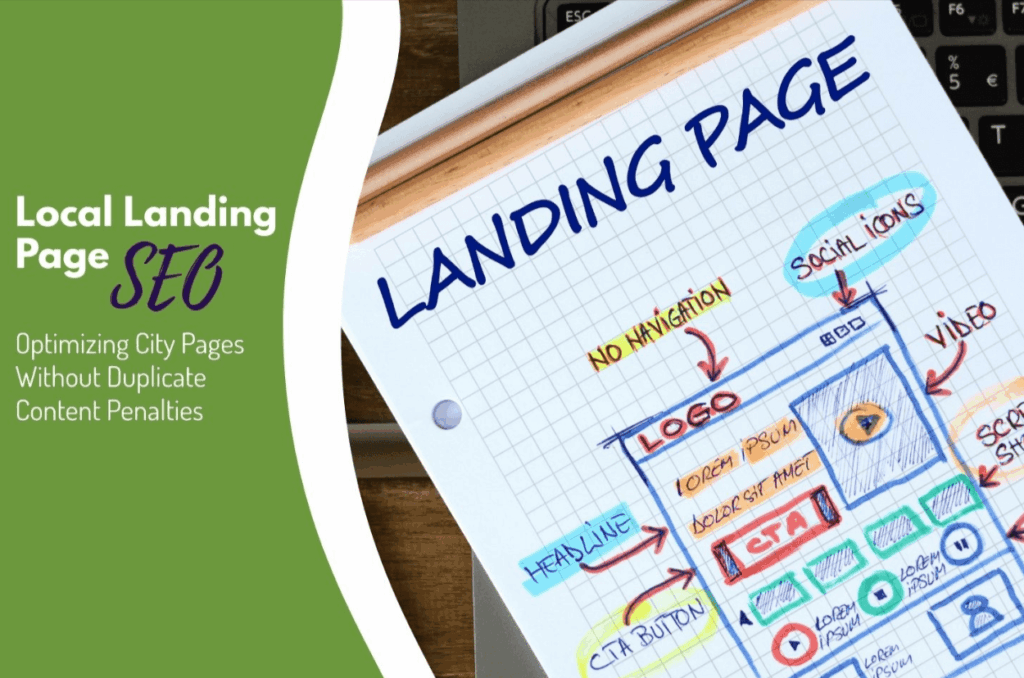
Local landing pages help Google understand what services you offer and where you offer them. If these pages are weak or duplicated, local rankings usually suffer.
Check whether each primary service possesses a separate page of its own rather than being included in a single general page. After that take a look at your location pages and ensure that they are distinctive, valuable, and written for actual users, not just for search engines.
Avoid copied or templated content across city pages. Thin or repeated pages provide little value and can reduce trust, which directly affects local search visibility.
Titles and Headings
Review page titles:
- Include service + location naturally
- Avoid repeating the same title on multiple pages
Headings should explain the service clearly, not just repeat keywords.
Internal Linking
Check:
- Are service pages linked from the homepage?
- Are location pages linked properly?
- Are anchors descriptive and natural?
Poor internal linking weakens local authority.
6. Technical Issues That Affect Local SEO
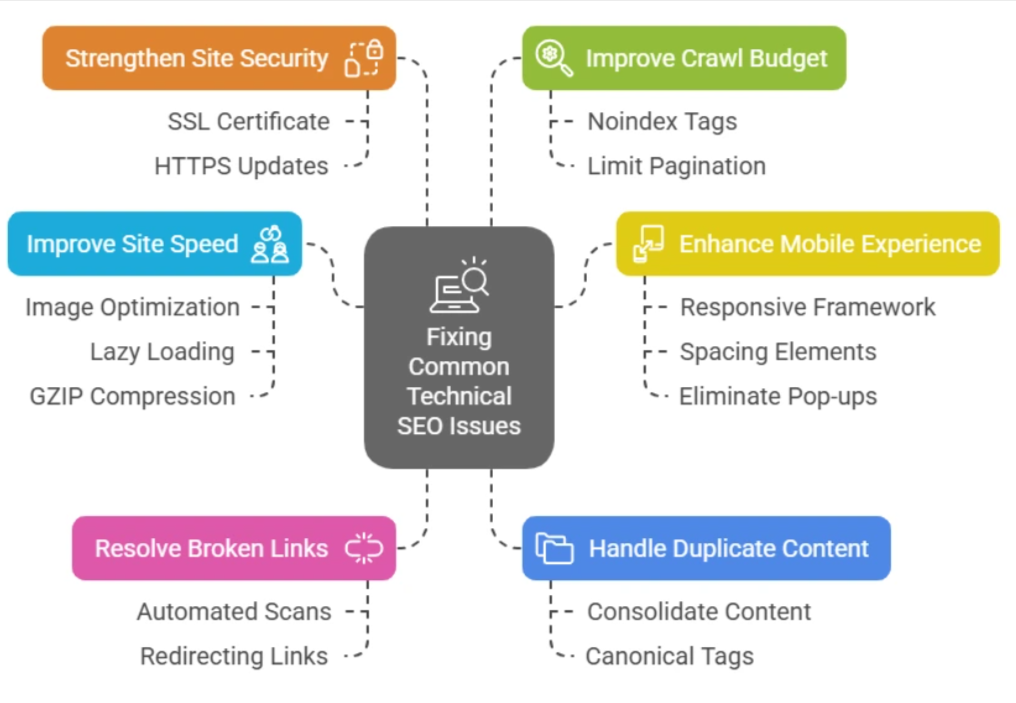
Technical issues can quietly block local rankings even when your content and Google Business Profile are well optimized. These problems affect how search engines access, understand, and trust your local pages.
Indexation Issues
Start by checking whether Google can properly index your important pages.
- Are important pages indexed?
Your main service and location pages must be indexed in Google. If they are missing from the index, they will not appear in local search results regardless of their quality. - Are any location pages blocked?
Location pages are sometimes blocked by noindex tags or robots.txt rules by mistake. This prevents Google from crawling and ranking them. - Are there wrong canonicals?
Incorrect canonical tags can point Google to a different page, causing the intended local page to be ignored or devalued.
If Google cannot index or recognize the correct page, local rankings will not improve.
Mobile Experience
Local searches are predominantly done on mobile devices, which means that mobile usability has a direct impact on local visibility.
- Page loading speed: Slow movement of mobile pages leads to an increase in bounce rates and a decrease in user engagement, this may cause the weakening of local ranking signals.
- Click-to-call buttons : Phone numbers should be clearly visible and easy to tap. Poor call accessibility reduces conversions from local traffic.
- Easy navigation : Users should be able to find contact details, services, and location information without scrolling or confusion.
Structured Data
Structured data helps search engines clearly understand your business information.
- Name, address, and phone must match GBP : Any mismatch between schema data and Google Business Profile can reduce trust and create inconsistency.
- Each location should have correct schema : Multi location businesses must use unique, location-specific schema instead of repeating the same data across pages.
Incorrect or missing structured data weakens local trust signals and ranking stability.
7. Local Content Audit
Local SEO content is a vital factor that helps to determine Google whether your business is truly relevant to a location. Generic or copied content weakens local trust and limits ranking potential.
Location Relevance
Review your content carefully to confirm that it reflects real services and real locations.
- Talks about real services you offer : Content should clearly explain the services you actually provide, including how they work and who they are for. Avoid vague descriptions that do not show practical knowledge.
- Mentions your service area naturally: Your city, neighborhoods, or service regions should appear in a natural context, such as explaining coverage areas or local availability, not in forced keyword placement.
- Includes real examples or processes: Describing how your service is delivered, common customer problems, or typical workflows helps make the content specific and locally relevant.
8. Reviews and Reputation Audit
Reviews are among the most powerful trust signals in local SEO. They affect both rankings as well as user choices, hence they should be scrutinized closely during a local SEO audit.
Review Quantity and Frequency
Start by analyzing the overall review pattern of your business.
- How many reviews you have : The total number of reviews has an impact on credibility. In most cases, the higher the number of reviews, the better but the quality and consistency of reviews count more than their number.
- How often new reviews come : Regular review activity indicates that the business is alive and reputable. A long period without new reviews might reduce local visibility.
- How you compare with competitors : Look at your review count and activity in comparison to the top-ranking competitors. This will reveal whether reviews are a competitive weakness or strength.
Review Content and Responses
Next, review what customers are actually saying and how you respond.
- Are reviews detailed or very short? : Detailed reviews yield stronger context and are more valuable for trust than one-word ratings.
- Do they mention services or locations? : Reviews that naturally bring up services or areas help to enhance local relevance.
- Do you reply to reviews professionally? : Regular, respectful replies signal active management and customer care.
9. Local Backlink Audit
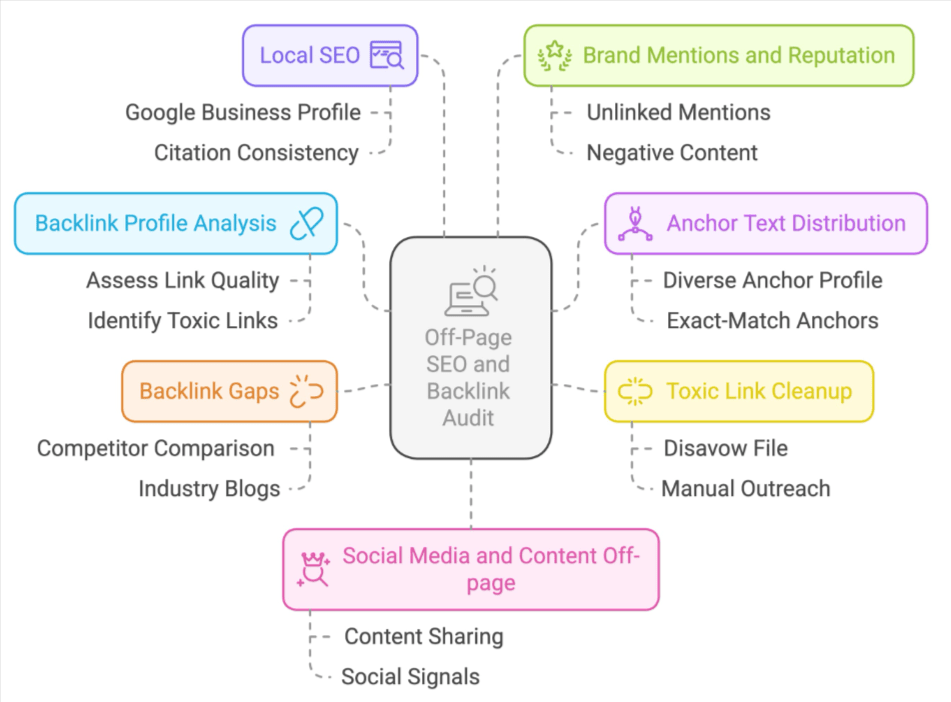
Backlinks help Google judge the authority and trust of your business. For local SEO, the relevance of links matters more than quantity.
Link Relevance
Evaluate the sources of your backlinks and how relevant they are to your business and location.
- Local websites Links from local businesses, organizations, or community sites indicate geographic relevance and help to increase local authority.
- Industry-related sites
Backlinks from websites within your service niche prove topical relevance and reinforce expertise. - Local news or blogs
Coverage by local news outlets or regional blogs gives strong trust signals and is hard to fake.
Toxic Links
Not all backlinks are helpful. Some can harm local trust and ranking stability.
- Spam directories
Links from low-quality or automated directories provide no real value and can weaken link quality. - Irrelevant foreign sites
Backlinks from unrelated countries or languages often signal unnatural linking patterns. - Over-optimized anchor text
Repeated use of exact-match keywords in anchor text can appear manipulative.
Final Thoughts
A full local SEO audit uncovers the precise problems that make you less visible in Google Maps and local search results. Instead of mere guessing, it reveals the shortcomings of your Google Business Profile, local pages, technical setup, reviews, or backlinks.
The right order of fixing these issues leads to consistent improvement in local rankings and conversions. Accurate business data, strong local relevance, and clear trust signals are the factors that push local SEO performance over the long run.
FAQs
What is a local SEO audit?
A local SEO audit is a meticulous inspection of your Google Business Profile, website, reviews, citations, and local backlinks in order to find issues that limit your visibility in local search and Google Maps.
Can a business rank locally without a website?
A business can show up on Google Maps simply by having a Google Business Profile, but usually, a properly optimized website is required for long-term local growth and competitive rankings.
Do location pages really matter for local SEO?
Yes. Properly written service and location pages help Google understand where and what you serve. Thin or duplicated pages can hurt rankings.
How many reviews are needed to rank locally?
There is no fixed number. Consistent, recent reviews with natural service mentions matter more than having a large number of old reviews.
Do backlinks still matter for local SEO?
Yes, but local relevance matters more than quantity. Links from local and industry-related sites are far more valuable than generic backlinks.