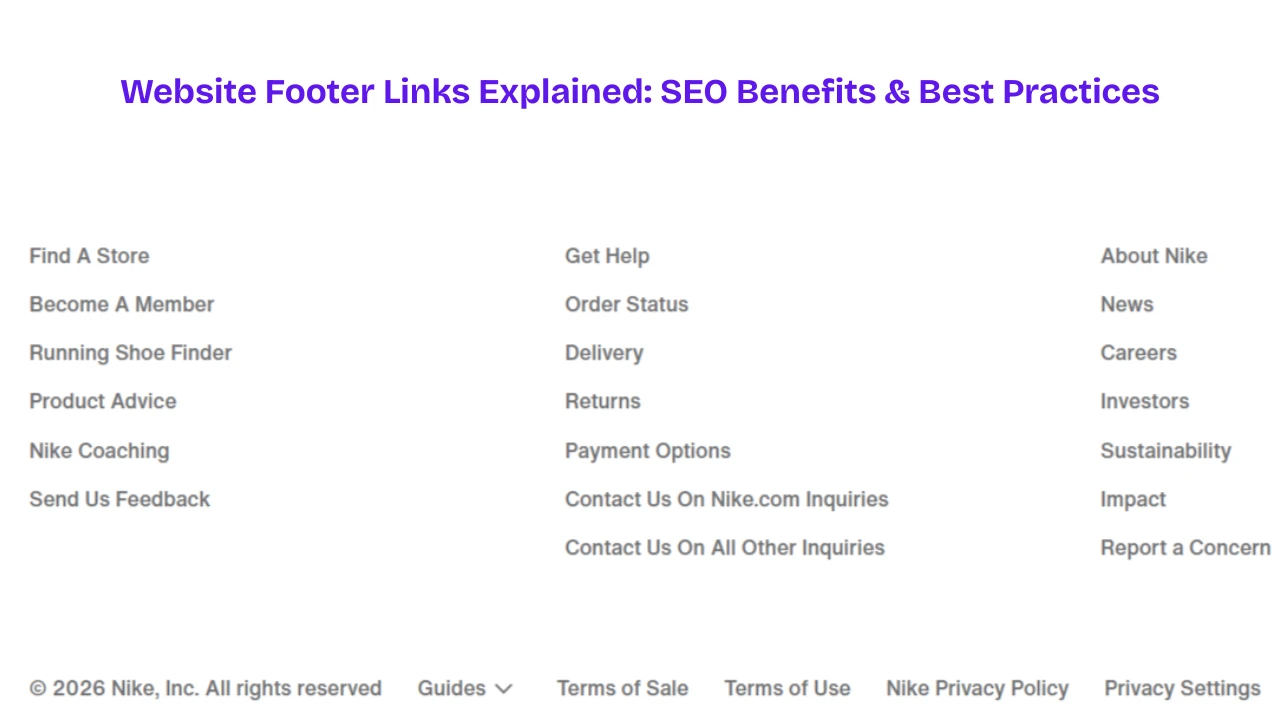
Website navigation greatly influences the user’s perception of a website. When users are unable to spot page links that are vital to them in the primary navigation menu, they usually go down to the end of the page. This habit makes the footer an area of significant but frequently overlooked website navigation.
Links in the footer are internal connections that are strategically placed in this location to lead users and additionally assist the search engines in comprehending the site structure. The quality of these links becomes very important as they are visible on several pages. This tutorial elaborates on the impact of footer links on SEO and the appropriate use of them.
What Are Footer Links?
Footer links are those links that are situated in the footer section of a webpage. This section generally appears on every single page of the website. These links, however, are not like content links since they are not placed within the articles or main content areas.
Search engines consider footer links as double links. This implies that they are not treated as editorial recommendations but are acknowledged as part of the website layout. This is the reason why these links do not pass on much ranking value as links found inside content. However, they still assist in pages’ discovery by the search engines and in understanding the site’s structure.
Types of Footer Links and Their SEO Purpose
Navigational Footer Links
Links in the navigational footer typically refer to pages like About, Contact, Privacy Policy, and Terms. Their primary function is to improve the user experience rather than to gain higher positions in the SERPs. These links are of help by leading the users to the pages of trust and support when they come to the bottom of a website.
Internal SEO Footer Links
Internal links in the footer usually direct to the key pages such as services, product categories, or content hubs. Their function is to ensure that critical pages are easily accessible and are not buried too deeply in the site structure.
Footer Links on Large Websites
Large websites use footer links to manage complex structures. Ecommerce sites often link to top-level categories, while publishers link to major topic hubs or archives.
External Footer Links
External footer links include partner links, certifications, or developer credits. Since they appear across all pages, they usually pass very little SEO value.
How Search Engines Treat Footer Links
The search engines classify the footer links as template links because of their consistent appearance across many pages. The repeated positioning of these links signals the intention of using them for navigation and site structure rather than for content relevance.
Footer links are not discarded by the search engines, still, their impact on ranking is quite limited. Due to the repetition of the same links throughout the site and their location at the bottom of the page, search engines cut down the weight they pass. Hence, footer links mainly assist in crawl access and structural understanding without having a direct influence on rankings.
Are Footer Links Good for SEO?
If used wisely, footer links can do wonders for SEO as they can change the website’s navigation and structure for the better. The primary function of these links is to facilitate user and search engine access to vital pages rather than directly increasing the website’s rankings.
How Footer Links Help SEO
- Guide users to key pages: Footer links can connect visitors to the main services, top categories, or helpful resources, so ensuring that important pages are reachable from all site sections.
- Support search engine crawling: Deep or hard to reach pages become accessible to the search engines through footer links. This also improves the efficiency of the crawling and guarantees that the important content gets indexed.
- Strengthen site hierarchy: Linking main categories or service hubs in the footer clarifies which are top level pages, thus helping the search engines understand the site structure and relationships between pages.
- Enhance user experiences: With a well organized footer, fewer clicks are required by users searching for essential pages, hence indirectly supporting SEO through improved engagement and a decrease in bounce rate.
Footer Links and Internal Linking Strategy
Footer links are a supporting part of an internal linking strategy. They connect important pages site-wide and complement content links, ensuring critical pages remain accessible without replacing contextual links.
How Footer Links Support Internal Linking
- Aid crawl efficiency – On large sites, footer links act as shortcuts, helping search engines navigate complex structures.
- Reinforce site hierarchy – Link top-level categories or main service hubs to show structural priority.
- Provide access to deep pages – Make nested or hard-to-reach pages discoverable for users and search engines.
- Support orphan pages – Pages with few internal links get consistent exposure through the footer.
- Maintain consistent navigation paths – Users can reach important sections from any page.
- Highlight high-priority or seasonal pages – Temporary campaigns or promotions can be linked for visibility.
Anchor Text Best Practices for Footer Links
Anchor text in footer links needs careful handling because it appears on every page. Misuse can look manipulative to search engines and confuse users. The goal is to make footer links clear, helpful, and safe for SEO.
Use simple and descriptive words like “Contact Us” or “Product Categories” to guide the users and give search engines an accurate context. Also, avoid using the same exact keywords across the pages because the repeated keyword-heavy anchors can be perceived as spammy.
Branded or general terms like “Our Blog” or “Customer Support” are safe and informative. In addition, keep anchor text short and concise so that users can quickly grasp the link’s purpose, which in turn naturally supports SEO.
Footer Links and Mobile SEO
On mobile, a lot of website footers are collapsible or hidden to maximize screen space. Nevertheless, even when the footer links are not fully exposed, they still remain readable and indexed by search engines, thus contributing to internal linking support.
However, not every hidden link is created equal. The presence of too many hidden links or a large grouping of links in collapsible menus may lead to devaluation, since search engines give more importance to visible and useful navigation. Thus, the quality and relevance should be the prime considerations, rather than the quantity.
Mobile usability is equally important. Links in the footer should remain easy to tap and navigate, with enough spacing to prevent accidental clicks. When designed with users in mind, mobile footer links provide both accessibility and structural value without harming SEO.
Footer Links and Google Spam Policies
Google evaluates footer links carefully because they have been misused in the past. Site-wide keyword links, paid links, and repeated template links were often used to manipulate rankings rather than help users.
links in the footer are safe when they serve real navigation purposes, such as “Contact,” “Privacy Policy,” or main category pages. These links improve usability and help search engines understand site structure without being seen as spam.
When footer links are excessively optimized, risks arise. Spam signals could be raised by exact-match keyword anchors, unrelated external links, or links to pages of little value. Even neutral links such as developer or partner credits might require a nofollow if they are present on numerous pages.
The main principle is very simple: footer links should be for users first. By using clear, descriptive anchor text and linking only to high value pages, they will function as support for internal linking and navigation at the same time as being compliant with Google’s spam policies.
Best Practices for SEO Friendly Footer Links
SEO-friendly footer links are all about being clear, consistent, and crawl-efficient rather than keyword-optimized. The focus should be on the footer functioning as an organized, easy-to-navigate, and meaningful part of the site architecture.
- Limit link count: Placing too many links in the footer makes the links weak and it will also be hard for users and search engines to know. First, pick essential sections and discard overlaps or remove low-priority links.
- Use descriptive, neutral anchor text : Avoid keyword stuffing. Anchors like “Support,” “Blog,” or “FAQs” are clear and safe, helping search engines understand the page context without raising spam flags.
- Organize links logically : Products, resources, or company information should be grouped together and related links put together. By grouping links logically, not only does it improve readability, but it also helps the search engines to interpret the site structure more effectively.
- Keep mobile usability in mind : Footers should always be easy to navigate for mobile users. Collapsing menus or well spaced links are ways to ensure that users can easily interact without getting frustrated and at the same time, search engines can crawl through all the links.
- Audit and update regularly : Checking footer links for broken URLs, outdated content, or unnecessary duplication is something that should be done regularly. Regular audits will keep your SEO hygiene in check and also prevent your crawl resources from being wasted.
Final Thoughts
links in the footer may seem like a minor detail, but they are still a strategic component for SEO. Well-structured footers facilitate the search engine’s access to deep pages, the establishment of consistent internal linking, and the management of crawl efficiency, especially on large or complex websites.
Links that are over optimized, like repeated keyword anchors or irrelevant external links can be ignored or even penalized. Descriptive anchor text and organized links not only ensure the search engines that they are safe, crawlable, and effective.
In reality, footer links work as a technical tool rather than a direct ranking factor. When implemented thoughtfully, they support indexing, internal link distribution, and overall SEO hygiene, providing lasting value without relying on manipulative tactics.
FAQs
Can Google penalize sites for footer link patterns?
Yes. Google monitors site wide footer links for manipulative patterns, such as repeated keyword anchors, paid links, or irrelevant external links. Sites using footer links purely for ranking can be flagged or ignored.
How do footer links affect crawl efficiency on large websites?
On sites with hundreds or thousands of pages, footer links act as consistent shortcuts for crawlers. They reduce crawl depth for pages buried under multiple categories or filters, helping Google index content faster.
Are hidden or collapsible footer links on mobile indexed differently?
No. Google can crawl hidden links in the footer in collapsible menus. However, excessive hidden links may be devalued, so it’s important that only relevant, structured links are included.
Should footer links include external sites?
External links in the footer are high risk if keyword optimized or excessive. Only include trusted partners or certifications, and consider using nofollow attributes to avoid passing unintended ranking signals.
Do footer links influence internal link equity?
They do, but minimally. links in the footer pass link signals across all pages, supporting indexing and connectivity, but they are less powerful than contextual links within content.