
Google’s AI Overviews have changed how search works. For years, SEO revolved around ranking on page one, winning featured snippets, and creating content that aligned with keyword intent. But AI Overviews introduced something new: answers generated directly by Google’s AI that appear before all traditional results.
This shift means people scroll less, click less, and rely more on Google’s summarised answers. If your content isn’t selected as a source — or if your niche depends heavily on top of funnel traffic — the impact can be major.
This article breaks down exactly how AI Overviews work, how they change SEO, who gets affected the most, and what actionable steps you can take to protect and grow your visibility.
1. What AI Overviews Are and How They Pull Information
AI Overviews are AI generated summaries shown at the top of search results. Instead of displaying one featured snippet, Google collects information from multiple reliable sources, rewrites it in natural language, and shows it as an instant answer.
AI Overviews pick their sources based on:
- Accuracy and topical clarity
- Strong, structured content
- Entity alignment (clear subject definitions and context)
- High trust and freshness
Google doesn’t always choose the top ranking page. It chooses the best structured, most contextually clear content it can understand.
2. Who AI Overviews Will Affect the Most
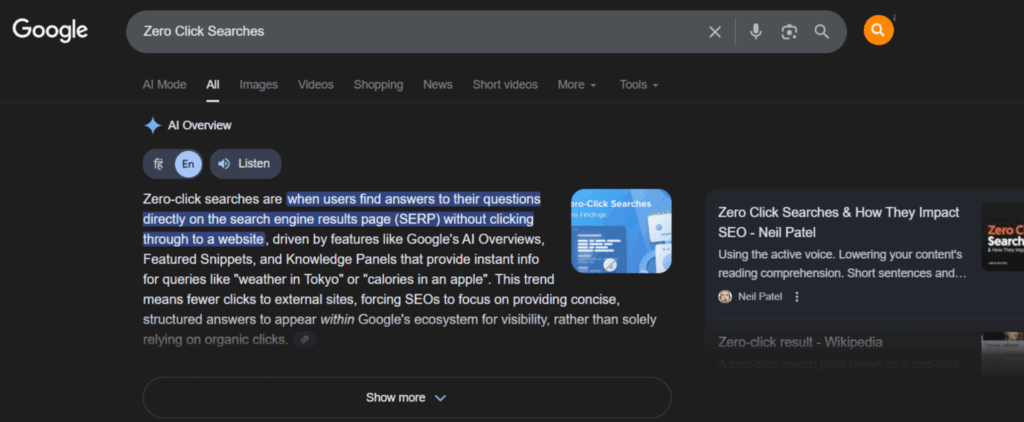
AI Overviews don’t impact every niche the same way. Certain industries and websites feel the pressure more than others.
2.1 Informational Sites with Broad Topics
Websites that depend on “what is,” “how to,” or quick explainer articles lose clicks the fastest. AI often answers these queries directly, leaving little reason for users to click.
2.2 Affiliate & Review Websites
If you run product roundups (“best laptops,” “top VPNs”), AI can summarise top choices and present them instantly — sometimes with product cards. This can reduce traffic to mid and top of funnel affiliate content.
2.3 YMYL Niches (Health, Finance, Legal)
Google restricts sources for sensitive topics. Only high authority or medically verified content is likely to be cited.
2.4 New or Low Authority Websites
AI Overviews pull from trustworthy, established entities. New sites must work harder to build topical authority, clarity, and trust signals to get cited.
3. How AI Overviews Change Search Traffic Dynamics
AI Overviews reshape how clicks flow from Google to websites.
3.1 Higher Zero Click Searches
Users get instant summaries, reducing the need to visit a website. This especially affects broad keywords.
3.2 Lower Click-Through Rates Even for #1 Results
Even if your page ranks first, it still sits below the AI block. That means fewer impressions turn into clicks.
3.3 The “Cited Source Advantage”
If your content appears inside the AI Overview (with a small link card), you may gain visibility that outperforms traditional ranking. Being inside the Overview can matter more than being #1.
4. Why Some Pages Get Picked for AI Overviews While Others Don’t
Google doesn’t just select “the best content.” It selects the content it can interpret most precisely.
4.1 Entity Clarity & Topical Alignment
Pages with clear definitions, consistent terminology, and strong topical focus perform better. Google wants content that maps cleanly to known entities (topics, concepts, brands, processes).
4.2 Strong Information Structure
Content that includes:
- clear headings
- short, factual paragraphs
- definitions
- steps
- examples
- comparisons
…is easier for AI to process and summarise.
4.3 Verifiable Information
Pages that include statistics, citations, expert insights, or first-party data appear more trustworthy. AI prefers sources it can fact-check, even partially.
5. How Much AI Overviews Will Affect SEO in the Future
AI Overviews are already shifting user behavior, and their impact will only grow as Google expands coverage and refines accuracy. More searches will be answered directly, reducing dependency on traditional blue-link clicks.
5.1 AI Overviews Will Trigger for More Query Types
Google currently limits AI Overviews to certain informational keywords, but this will widen quickly. As the model improves, more commercial, research focused, and general queries will trigger AI summaries, affecting a larger share of organic traffic.
5.2 Generic Keywords Will Lose the Most Traffic
Basic, high level queries like “how to start a blog” or “what is inflation” are easiest for AI to summarise instantly, so these will see the biggest drop in clicks. Sites relying heavily on beginner-level content will feel the strongest decline.
5.3 Authority Will Matter More Than Ever
Google increasingly favours trusted, expert-backed websites when selecting sources for AI Overviews, making EEAT signals essential. Strong author credibility and transparent sourcing will determine who gets included and who gets ignored.
5.4 Ranking Volatility Will Increase
Because AI models update rapidly, the sources chosen today may change tomorrow based on freshness, clarity, and accuracy. This creates a more volatile SEO environment where constant content improvement becomes necessary.
6. What You Can Do to Appear Inside AI Overviews
If you want your content to be featured in Google’s AI Overviews, it’s necessary to facilitate algorithms when digesting, summarizing, and trusting the information on your pages. That makes both your visibility and Google’s confidence in you.
6.1 Optimize for Entity Recognition
Google uses entities (people, brands, tools, concepts) to figure out what your content stands for. Language should be accurate and well used, sometimes accompanied by synonyms and others by phrases providing context, for Google to easily connect with the subject matter. Internal links also define how you associate specific key points all over your site.
You can help increase the machine readability of your content by also adding schema markups around entities like organizations, products, authors, or FAQs. This will highlight Google’s connection from your page to other subjects in the search engine, increasing the chances that it will be featured in AI Overviews.
6.2 Write Summarizable Content
AI Overviews prefer content that can be broken down into clean, digestible pieces. Keep one idea per paragraph, use clear section breaks, and write short “what/why/how” explanations. This helps Google identify and extract the most meaningful information.
Bullet points, step lists, and concise definitions make your content easier for algorithms to convert into summaries. The less fluff you use, the more likely your content is selected.
6.3 Increase Your Fact Density
Pages rich in factual information get prioritized. Include stats, timelines, comparisons, real examples, and first party insights. These elements give Google reliable, structured data to build summaries.
The more concrete information you provide, the easier it becomes for AI Overviews to treat your content as a trusted source for quick answers.
6.4 Strengthen Trust and Author Identity
Google wants to showcase content from trustworthy, transparent sources. Add strong EEAT signals like an author bio, credentials, expert profile links, citations, and updated timestamps. These elements show that real expertise stands behind the content.
Outgoing links to reputable sources also boost authority. The more traceable and verifiable your information is, the more confident Google becomes in using it.
6.5 Implement Helpful Schema Markup
Schema markup doesn’t guarantee inclusion, but it increases machine understanding of your page. Google uses structured data to interpret the purpose and format of your content more efficiently.
FAQ, HowTo, Article, Product, Review, and Author/Organization schema are especially useful for AI Overview visibility. They tell Google exactly how your information is structured, making it easier to extract and summarize.
7. How to Protect Your Traffic Even If AI Overviews Reduce Clicks
AI Overviews aren’t going away, but you can protect your SEO traffic by focusing on content types and SERP elements that AI cannot replace or summarize accurately.
7.1 Target Query Types With Low AI Overview Coverage
AI struggles with queries that require nuance, depth, or personal reasoning. Build more content around these categories:
- Complex problem solving topics that depend on detailed scenarios, troubleshooting steps, or situational variables.
- Advanced tutorials & long form guides with multi-step setups, technical explanations, and in-depth walkthroughs.
- Niche long-tail questions with highly specific user intent, local context, or narrow industry focus.
- Strategy based content where answers require judgment, decision-making, and contextual reasoning.
- Opinion driven or experience based articles that rely on personal lessons, firsthand results, or lived expertise.
7.2 Create Original Content AI Can’t Copy
Generic content gets summarized, but original work cannot. Focus on content that Google must cite or link because it’s uniquely yours:
- Proprietary data from your analytics, customer behavior, pricing research, or market insights.
- Unique experiments you run and document, including tests, A/B results, and technical trials.
- Original surveys conducted through your audience, community, or mailing list.
- Firsthand insights based on your workflow, expertise, and personal observations.
- Real case studies that show what you did, why you did it, and what changed.
- Personal frameworks or methods that you create, name, and explain step-by-step.
7.3 Improve On SERP Click Appeal
Even below an AI Overview, you can still win the click by making your search snippet more compelling than the competition:
- Sharper, specific title tags that include outcomes, real tests, years, or target segments to stand out.
- Benefit driven meta descriptions that highlight what readers will get, not just what the page covers.
- FAQ schema enhancements that add extra rows under your listing and push competitors down.
- Bolded keyword alignment by using natural phrasing that matches the exact query users search for.
- Clear, high value opening paragraphs that deliver definitions, stats, or steps upfront to earn snippet priority.
FAQs
Will AI Overviews replace organic search results completely?
No. They’ll mainly reduce clicks for broad, easy-to-answer queries, but full organic results will remain essential for depth and detailed information.
Is schema required to appear in an AI Overview?
Not required, but very useful. Schema helps Google understand your content structure, making it easier for AI to extract and summarise the right information.
Can small websites get featured in AI Overviews?
Yes. Google often picks clear, niche-specific, well-structured content—even from small sites—if it provides stronger summaries than big publishers.
How do I know if my traffic drop is due to AI Overviews?
If impressions stay steady but clicks fall for certain keywords, it usually means users are getting answers directly from the AI Overview instead of visiting your page.
Does EEAT matter more now?
Yes. Strong expertise, clear author identity, and reliable sources heavily influence which sites Google chooses for AI Overviews.
Conclusion
AI Overviews are reshaping how users interact with Google, and while they won’t erase organic search, they will change where traffic comes from and which types of content win visibility. The real advantage now goes to websites that produce clear, trustworthy, summarizable information backed by genuine expertise.
SEO is not disappearing—it’s evolving. Brands that embrace this shift early will capture new opportunities, maintain stable traffic, and stay visible even as search becomes more AI-driven.